The $10 Device Some Call Dangerous Is a Metaphor for All Technology -- Silencer from ElevenLabs.
One of the most controversial gadgets of the year cost just $10. Some people loved it and some people were furious about it. I think it's also a perfect metaphor for technology itself.
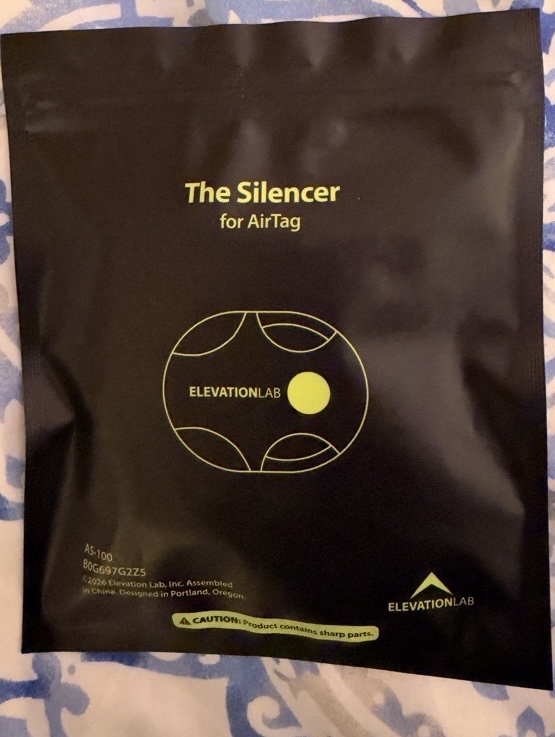
The device is the Silencer, from Elevation Lab, a company that makes good Apple accessories. It came out at the end of September, and it did one thing: it disabled the speaker in an AirTag.
Why would you want that? Say you hide an AirTag on your bicycle and someone steals it. The AirTag notices that it's traveling with someone who isn't its owner, and it starts beeping. That tells the thief there's a tracker on the bike, and the thief tosses it. The Silencer guides a pin to exactly the right spot to break the speaker, so the AirTag keeps reporting its location but stays quiet.
Why I bought one
I have a lot of AirTags. My kids are both in college, and over the years I've handed them plenty. One ended up in my daughter's old tennis bag. She later gave me the bag, forgetting the AirTag was inside, and now every time I pick it up to go play tennis, it starts beeping at me.
I also have AirTags in my car, in a few expensive coats and in my luggage. If someone steals any of those, I don't want the AirTag announcing itself. So when the Silencer showed up on Amazon for $10, I bought one. It arrived, and I still haven't opened it.
The other side
What I didn't think about is the problem a lot of people quickly pointed out. That beep isn't only there to annoy thieves. It's a safety feature. It warns people when someone has slipped an AirTag into their bag or car to track them. A silenced AirTag is a stalker's tool. Someone could use one to follow a former partner without her ever hearing a thing. That's terrible, and in most places it's illegal.
To be fair, you could already do this. There are videos online showing how to kill an AirTag's speaker with a nail. But the Silencer made it easy, and it made it something you could buy for ten dollars.
Glenn Fleishman at Six Colors, whose writing I enjoy, was appalled. On October 1 he wrote "Silencing AirTags Enables Stalkers and Domestic Violence," arguing that the device makes it easier for abusers to hide their surveillance. I understand his point completely. Technology can be used to do awful things.
About two weeks later, Elevation Lab pulled the Silencer (Six Colors followed up too). The company said:
We launched an AirTag silencing tool recently. We've always made products we want for ourselves, and this was no different. We wanted it for AirTags on our bikes. Some of us have bikes more valuable than our cars. In retrospect, though, this also has the side effect of aiding someone with bad intentions to track someone who wouldn't get phone notifications. We have removed the product and will use our patent on it to prevent anyone else from making one in the future.
I respect that decision.
Good and bad at the same time
Here's why this little device stuck with me. The same $10 gadget is good or bad depending entirely on whose hands it's in. That's true of almost every technology we argue about.
Take social media: Facebook, TikTok, X. Some people say it's bad for us. It can make people, especially young people, anxious and depressed, and Facebook has been sued over exactly that. Others say it's good because it connects people who would never have found each other otherwise. Both sides are right.
Now artificial intelligence. Some people say AI will help cure cancer, make our jobs easier, and help us build things faster. Others say people will lose their jobs, and that students will stop learning because they'll just let AI do their homework. Again, both sides have good arguments.
Nuclear technology is the most extreme example. The atomic bombs dropped on Hiroshima and Nagasaki helped end World War II, and they killed well over a hundred thousand people. Nuclear weapons could still destroy the world. Yet nuclear energy could also help free us from oil and the pollution it causes.
Whatever we think, technology keeps moving forward. The question is always how we use it.
A museum piece
I don't know if I'll ever open my Silencer. Elevation Lab doesn't sell it anymore, and maybe someday it belongs in a museum as a reminder. I completely understand why people were upset. Someone with bad intentions could use it to hurt someone. I also understand why it was made: people with expensive bikes didn't want a thief to hear the AirTag and throw it away.
This $10 device made me think harder about technology than most $1,000 ones do. It's good and it's bad, and usually it's both at once.